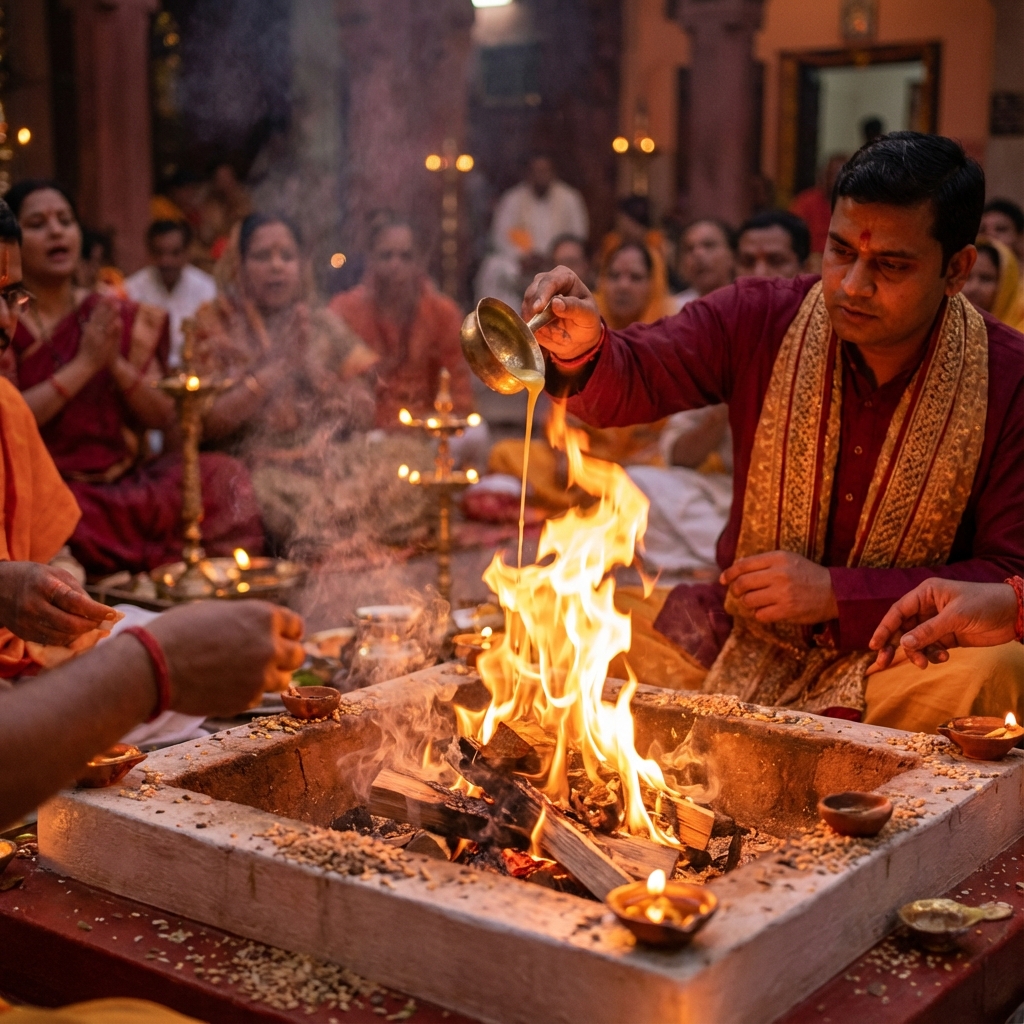
Jai Santoshi Mata! The Santoshi Mata Vrat Udyapan is the grand culmination of the sacred 16 Friday Fasts (Solah Shukravar Vrat), a ritual observed for the fulfillment of one's deepest desires, peace, and prosperity.
Santoshi Mata, the Goddess of Satisfaction (Santosh), is widely revered as the daughter of Lord Ganesha and Riddhi-Siddhi. She is the embodiment of gentleness, contentment, and forgiveness. Devotees, particularly women, observe this fast for 16 consecutive Fridays with unwavering devotion to seek her blessings for a happy married life, the well-being of their husbands, the birth of a child, or relief from poverty and debt.
The Udyapan (Closing Ceremony) is the most critical part of this vow. It is believed that the Vrat is incomplete without a proper Udyapan performed according to Vedic Vidhi. This ceremony is not just a ritual but a celebration of faith, where the devotee offers gratitude to the Mother for listening to their prayers.
Who is Santoshi Mata?
According to Hindu mythology and folklore, Santoshi Mata is a powerful form of the Mother Goddess. She is seated on a lotus, symbolizing purity, and holds a sword, a golden pot of rice, and a trident in her hands, representing her power to destroy evil and nourish her devotees. Her name, "Santoshi," literally translates to "One who is satisfied" or "One who bestows satisfaction."
The worship of Santoshi Mata gained immense popularity after the release of the 1975 devotional film "Jai Santoshi Maa," which brought her miraculous stories to the masses. However, her presence in local folklore has traditionally been significant. She is believed to be the one who accepts the simplest of offerings—Gur (Jaggery) and Chana (Roasted Gram)—and grants the biggest of boons. Unlike other deities who might require elaborate rituals, Santoshi Mata is pleased with pure devotion and adherence to the strict rule of avoiding sour foods (Khatai).
The Significance of the 16 Friday Vrat
The Solah Shukravar Vrat is a journey of discipline and faith. It is started on a Friday of the Shukla Paksha (Waxing Moon phase). For 16 weeks, the devotee maintains a strict fast, eating only one meal a day and ensuring that no sour ingredient—like lemon, tamarind, curd, tomatoes, or unripe fruits—touches their lips or serves as part of their meal. This restriction extends to the entire household on the day of the Puja.
The number 16 represents the 16 phases of the moon (Shodasha Kala), symbolizing completeness. By observing this fast for 16 Fridays, devotees align themselves with the cosmic rhythm and purify their mind, body, and soul. The fast is known to:
- Remove Obstacles: Just as her father Ganesha is Vighnaharta, Santoshi Mata removes hurdles in marriage and career.
- Grant Progeny: Childless couples have reported miraculous conceptions after observing this Vrat.
- Bring Financial Stability: The Goddess of Satisfaction ensures her devotees never go hungry or face abject poverty.
- Restore Family Peace: It is a powerful remedy for domestic conflicts, especially between mothers-in-law and daughters-in-law, as highlighted in her Vrat Katha.
The Miraculous Vrat Katha (Story)
No Udyapan is complete without reading or listening to the sacred story of Santoshi Mata. This story is the heart of the ritual.
The Old Woman and Her 7 Sons
Once upon a time, there lived an old woman who had seven sons. She was cunning and favored her six elder sons because they were earners, while the youngest son, who was unemployed and simple, was neglected. She would serve the elder sons grand meals with delicious dishes, but to the youngest son, she would essentially serve the leftovers or plain scraps. The youngest son, innocent and unaware of this discrimination, believed his mother loved him.
One day, his wife, a pious and observant woman, told him the truth. "Look at what your brothers eat and look at what you are served," she said. The son decided to test this. He feigned sleep in the kitchen and saw his mother cooking a feast for his brothers while keeping aside mere crumbs for him. Heartbroken, he confronted his mother, who dismissed him coldly, saying, "They earn, they eat. You are a burden."
Stung by these words, the youngest son decided to leave the house to seek his fortune. He told his wife, "I will go to a faraway land and will return only when I am wealthy." His wife, weeping, gave him a farewell, and he left behind a ring as a token of his love.
The Wife's Suffering
After he left, the days turned into nights of misery for the wife. The mother-in-law and sisters-in-law tortured her. They made her do all the household chores, from fetching water to cutting wood, and gave her only a piece of roti with water. She lived in a small hut outside the main house, passing her days in sorrow, waiting for her husband.
One day, while collecting wood in the forest, she saw a group of women worshiping a Goddess. They were performing a Puja with simple offerings of Jaggery (Gur) and Gram (Chana). Curiosity struck her, and she asked, "Mothers, who are you worshiping? What is this fast?"
The women replied, "This is Santoshi Mata. She is the granter of all wishes. If you fast on 16 Fridays with devotion, offer Gur-Chana, and avoid sour food, she will fulfill your heart's desire."
The Miracle of the Vrat
The wife immediately made a vow (Manokamna) to perform the Vrat for her husband's safe return. She bought Jaggery and Chana with the few coins she had and started the fast.
Miraculously, in the faraway land, her husband found a job with a wealthy merchant. Through hard work and honesty, he eventually became a partner in the business and accumulated immense wealth. However, he had forgotten his home. Santoshi Mata appeared in his dream and reminded him of his wife waiting in misery.
Jolted by the dream, he packed his bags with wealth, jewelry, and gifts and returned home. The news of his arrival shocked the mother and other wives. When he reached home, he was appalled to find his wife in a dilapidated hut. He learned of her loyalty and the power of her Vrat. He took her back, and they set up a separate, opulent household.
The Udyapan and the Final Test
The wife decided to perform the Udyapan (Conclusion Ceremony) of her fast. She invited eight boys from the neighborhood for the feast. But her jealous sisters-in-law plotted against her. They taught their children to ask for something sour (Khatai) during the meal.
During the Udyapan feast, the boys started demanding, "Give us something sour! Give us buttermilk or tamarind!" The wife refused, knowing the rules. But the sisters-in-law gave the children money to buy tamarind from a shop and eat it.
The moment the sour food was consumed, disaster struck. The King's soldiers arrested the husband on false charges of murder. The wife was devastated. She prayed to Santoshi Mata, asking, "Mother, what happened? I performed the Puja with devotion!"
Mata appeared and revealed, "Your Udyapan was corrupted by sour food. This is the consequence." The wife begged for forgiveness and vowed to perform the Udyapan again. Mata forgave her. The husband was miraculously released, and the King even honored him.
The wife performed the Udyapan again, this time with strict vigilance. She fed the Brahmin boys and gave them gifts. Santoshi Mata blessed the couple with a beautiful son and lifelong prosperity. The mother-in-law and others realized their mistake and bowed before the boundless mercy of Santoshi Mata.
Bolo Santoshi Mata Ki Jai! Just as the Mother blessed the daughter-in-law, may She bless everyone who performs this Vrat and reads this story.
Comprehensive Udyapan Vidhi
A Step-by-Step Guide to the Closing Ceremony
1. Preparation & Purification
On the day of Udyapan (usually the 17th Friday), wake up during Brahma Muhurat (before sunrise). Clean the entire house thoroughly. Sprinkle Gangajal to purify the surroundings. Take a bath and wear fresh red or pink clothes. Red is dear to the Goddess.
2. Altar Setup (Mandap Sthapana)
- Place a wooden chowki (low table) and cover it with a red cloth.
- Place the photo/idol of Santoshi Mata. Also, place a photo of Lord Ganesha (her father) and Riddhi-Siddhi.
- Kalash Sthapana: Fill a copper/brass pot with water. Put a coin, a betel nut, a flower, and some rice grains inside. Place 5 mango or betel leaves at the mouth and top it with a coconut wrapped in red cloth (Chunari). This represents Varuna Devta and the cosmic universe.
- Light a Ghee Diya (oil lamp) and incense sticks.
3. Ganesh & Mata Puja
Always begin with Ganesh Pujan. Chant "Om Gam Ganapataye Namaha" and offer flowers and Akshat (rice) to Lord Ganesha. Pray for the removal of obstacles for the Udyapan.
Then, proceed to Santoshi Mata Pujan:
- Avahan: Invite the Goddess into your home.
- Vastra & Shringar: Offer a Red Chunri, Bangles, Sindoor, and Bindis to the Goddess. This "Suhag Pitara" is crucial for marital bliss.
- Pushpa Arpan: Offer red hibiscus or roses.
- Bhog: Make the primary offering of Gur (Jaggery) and Chana (Roasted Gram). This implies simplicity and humility. You can also offer Halwa and Puri (made without salt or any sour agent).
4. Katha & Havan
Read the Vrat Katha (story detailed above) loud and clear. Hold some flowers and rice in your hand while listening. After the story, offer the flowers to the Goddess.
Havan (Fire Ritual): A small Havan is performed to invoke Agni Dev.
- Light the Havan Kund with mango wood and camphor.
- Chant "Om Santoshi Devyai Namaha Swaha" and offer a mixture of Ghee, Gur, and Chana into the fire 108 times.
- The smoke from the Havan purifies the house and takes the prayers to the heavens.
5. Kanya/Batu Bhojan (The Feast)
This is the most unique aspect of Santoshi Mata Udyapan. You must invite 8 boys (signifying the 8 forms of satisfaction or the sons of the Goddess/Ganesha). If boys are not available, girls can also be invited.
- Wash their feet as they enter. This is honoring the Divine in them.
- Serve them the Prasad meal: Puri, Chana Curry, Kheer, and Halwa.
WARNING: Do not serve curd, pickles, or anything sour. Not even fruits like oranges. - After the meal, give them gifts (Dakshina). Common gifts include a fruit (Banana), money, or a small steel bowl.
- Touch their feet and seek blessings.
6. Visarjan & Conclusion
Perform the final Aarti singing "Jai Santoshi Mata, Maiya Jai Santoshi Mata...". Distribute the Prasad to family members and neighbors. Only after everyone has eaten should the devotee break their fast. The water from the Kalash should be sprinkled in the house (Tulsi plant) and the coconut can be consumed later as Prasad.
Complete Samagri List (Checklist)
To ensure the Puja flows smoothly, please keep the following items ready. Our Pandit will bring the specific ritual utensils and essential Havan samagri, but you should prepare the household items.
Essential Puja Items
- ▪ Photo/Idol: Santoshi Mata and Ganesh Ji.
- ▪ Offering: 250g Jaggery (Gur) & 250g Roasted Gram (Chana).
- ▪ Flowers: Red Roses or Hibiscus garland.
- ▪ Cloth: Red cloth for altar (1 meter).
- ▪ Kalash Setup: Copper pot, Coconut, 5 Mango/Betel leaves.
- ▪ Diya: Ghee, Cotton wicks, Matchbox.
- ▪ Incense: Agarbatti and Dhoop.
For Shringar & Udyapan
- ▪ Suhag Items: Red Chunari, Bangles, Sindoor, Bindi, Mehendi cone.
- ▪ Bhojan: Puri, Chana Curry, Kheer (Rice pudding), Halwa.
- ▪ Havan Samagri: Ghee, Havan Kund (if small), Wood, Camphor.
- ▪ Dakshina: Coins/Cash and Fruits (Bananas) for 8 boys.
- ▪ Punchamrit: Milk, Curd (Use sparingly/symbolically or avoid if strictly following no-sour rule), Ghee, Honey, Sugar. *Note: Some traditions avoid curd in Panchamrit for this specific puja.
Expert Answers to Common Questions
Q1.What if I accidentally eat something sour during the Vrat?
If you consume sour food by mistake, the fast is considered broken (Khandit). You should ask for forgiveness from the Goddess and observe one extra Friday making the total 17 before doing the Udyapan. Do not perform Udyapan if the last fast was broken.
Q2.Can I perform Udyapan if I don't have 8 boys?
Traditionally, 8 boys are preferred. However, if you cannot find 8 boys, you can invite girls, or even feed a cow (Gaumata). You can also donate the raw ingredients (Sidha) for 8 meals to a temple priest.
Q3.Is it necessary to read the Katha loud?
Yes, Shravan (listening) is a key part of Bhakti. Reading the story loud allows others in the family to hear the glories of the Mother, spreading positive energy.
Q4.Can men observe this fast?
Absolutely. While it is popular among women for marital bliss, men can observe Santoshi Mata Vrat for business success, job stability, and debt removal. The rules remain the same.
Q5.What is the best time to start the 16 Fridays?
You should start on the first Friday of the Shukla Paksha (Waxing Moon) in any auspicious month. Shravan and Kartik months are considered highly auspicious.
Q6.Can a pregnant woman perform Udyapan?
Yes, a pregnant woman can perform the Puja. However, if she finds it difficult to fast or cook for 8 boys, she can take the help of family members. If health doesn't permit, she can postpone the Udyapan until after delivery.
Q7.Why is the Jaggery and Gram combination so important?
It represents the simplicity of the Goddess. Unlike other deities who may need 56 Bhog, Santoshi Mata is the 'Mother of Satisfaction'. She is pleased with the most basic, affordable food, teaching us that devotion matters more than wealth.
Divine Benefits of Santoshi Mata Vrat
Devotees who perform this Udyapan with a pure heart witness life-changing miracles. It is a powerful remedy for those who feel their life is stagnant.
Marital Bliss
Resolves misunderstandings between couples and ensures the long life of the husband.
Progeny (Santan Prapti)
Many childless couples have been blessed with healthy children after observing the 16 Fridays.
Wealth & Prosperity
Removes the shadow of poverty (Daridrata) and brings financial stability to the home.
Success in Exams
Students observing this vrat find increased focus and success in competitive exams.
Jump to Section
Related Puja Services
Explore other authentic Vedic rituals performed by our expert pandits
Satyanarayan Vrat Udyapan
Book verified pandit for satyanarayan vrat udyapan in Pune. Same-day booking. Transparent pricing. Authentic Vedic rituals.
Pradosh Vrat Udyapan
Book verified pandit for pradosh vrat udyapan in Pune. Same-day booking. Transparent pricing. Authentic Vedic rituals.
Ekadashi Vrat Udyapan
Book verified pandit for ekadashi vrat udyapan in Pune. Same-day booking. Transparent pricing. Authentic Vedic rituals.
*Book experienced Vedic Pandits for Santoshi Mata Vrat Udyapan in all localities of Pune and PCMC.