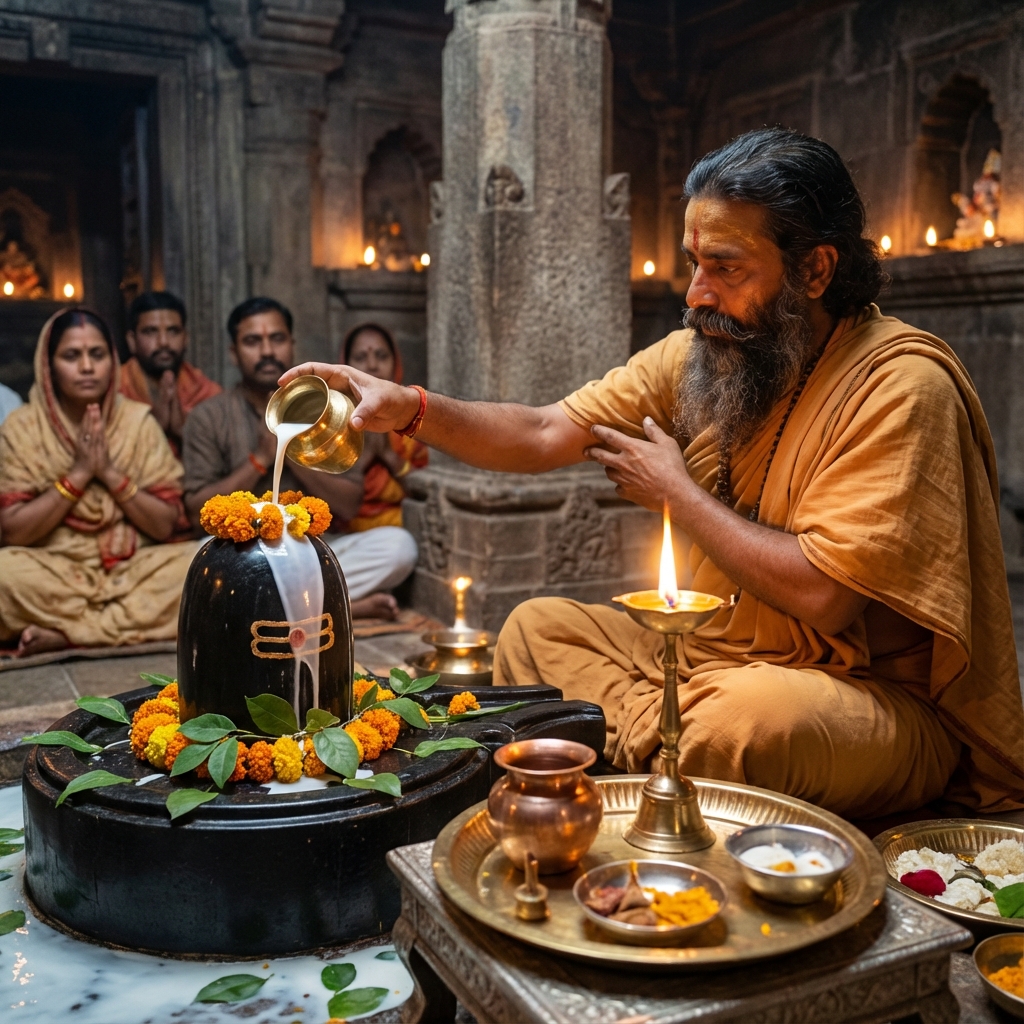
Om Namah Shivaya! The Somvar Vrat Udyapan (Solah Somvar Vrat Udyapan) is the powerful conclusion of the 16 Mondays Fast dedicated to Lord Shiva and Goddess Parvati.
Mondays (Somvar) are ruled by the Moon (Soma), which is adorned on Lord Shiva's head (Chandrashekhar). The Moon represents the mind. By fasting on Mondays, one gains control over the mind and emotional stability. However, the special Solah Somvar Vrat is a more rigorous and specific observance undertaken for the fulfillment of extremely difficult wishes, such as finding a suitable life partner, curing chronic diseases, or overcoming impossible financial hurdles.
The Udyapan is performed on the 17th Monday. It is believed that without the Udyapan, the fruit of the 16 fasts remains locked. The ceremony involves a grand Rudrabhishek, the special preparation of 'Rot' (sweet wheat cakes) Prasad, and a Havan to please the Divine Couple, Shiva and Shakti.
The Historical & Spiritual Significance
The tradition of the 16 Mondays fast is as old as the Puranas. It is said that Goddess Parvati herself observed this fast to win Lord Shiva as her husband. In later times, Draupadi and the Pandavas are also believed to have performed Shiva Pujas to regain their lost kingdom.
This Vrat is unique because of its specific 'Prasad' rule. Unlike other fasts where fruit or general sweets are offered, the Solah Somvar Vrat requires the devotee to prepare a special Churma or Rot using Wheat Flour, Ghee, and Jaggery. This Prasad must be consumed at the temple or the place of worship and cannot be taken home or wasted. This teaches the lesson of 'Aparigraha' (non-hoarding) and complete surrender to the Divine presence in the moment.
The Sacred Solah Somvar Katha
The power of the 16 Mondays is best understood through its traditional story, which describes how even the cursed can be blessed.
The Game of Dice and the Priest's Curse
Once, Lord Shiva and Goddess Parvati visited the beautiful city of Amravati. They decided to stay in a Shiva temple. To pass the time, Parvati Devi suggested playing a game of Chausar (dice). As they were playing, a Priest (Pujari) entered the temple. Parvati asked him, "O Knowledgeable One, tell us, who will win this game?"
The Priest, without thinking appropriately, said, "Lord Shiva keeps the universe in balance; surely He will win." However, when the game concluded, Parvati had won. Angered by the Priest's false prediction and sycophancy, Parvati cursed him to become a leper. "A Priest must speak the truth," she declared. The Priest was instantly afflicted with leprosy and lived a miserable life of pain and isolation.
Redemption through 16 Mondays
Years passed. Some celestial nymphs (Apsaras) visited the temple and saw the suffering Priest. They asked him the cause of his condition. The Priest narrated his tale of the curse. The benevolent Apsaras advised him, "Do not despair. Observe the Solah Somvar Vrat (16 Mondays Fast). On the 17th Monday, perform the Udyapan with half a seer (approx 500g) of wheat flour cooked with ghee and jaggery. Lord Shiva will surely heal you."
The Priest followed their instructions meticulously. He fasted for 16 Mondays without water/food until sunset, offered the Prasad, and on the 17th Monday, performed the Udyapan. Lord Shiva was pleased, and the Priest was cured of leprosy, regaining his healthy form.
Later, Shiva and Parvati visited the temple again. Parvati was surprised to see the Priest healed. She asked, "Who cured you of my curse?" The Priest described the Solah Somvar Vrat. Parvati, intrigued, decided to perform the same Vrat to win over her son Kartikeya, who had gone away from her in anger. Her wish was granted, and Kartikeya returned.
The Brahmin's Son Journey
The story continues as Kartikeya asked his mother about the Vrat. He then performed it to reunite with a lost friend. the friend (a Brahmin) performed it to find a cure for his severe abdominal pain. Eventually, the Vrat's fame spread.
A rich merchant's son decided to perform the Vrat to find a wife. He went to a distant city where a King had organized a Svayamvara for his daughter. The condition was that the princess would garland the man around whose neck a garland would fall from the sky (or an elephant would place it). The merchant's son was fasting on a Monday. He sat in the assembly. Through the power of his Vrat, the garland fell on his neck. The King married his daughter to him.
The Tragedy of Neglected Prasad
Years later, the Merchant's son and the Princess return to his home. On the way, they stopped at a temple to perform the Somvar Puja. The wife (Princess) refused to go in, sending her maid instead. The maid attended the Puja, ate the Prasad, and brought some for the Princess. However, the Princess ate it without reverence.
This disrespect caused the King's soldiers to capture the Princess, mistaking her for a thief (due to an illusion created by Shiva’s displeasure). The merchant's son was devastated. He prayed and realized his wife had insulted the Vrat Prasad. He performed the Vrat again for her release. Shiva forgave them, the King realized his mistake, and the couple was reunited. Since then, they observed the Vrat faithfully and lived happily.
This story emphasizes two things: 1) The power of the Vrat to fix even 'cursed' fates. 2) The absolute necessity of respecting the Prasad and the Vidhi.
The Authentic Udyapan Vidhi
Performed on the 17th Monday
1. The Unique 'Rot' Preparation
This is the most critical part distinguishing Somvar Udyapan from regular Rudrabhishek.
Ingredients Ratio:
Traditionally, it requires "Sava Ser" (approx 1.25 kg) of Wheat Flour. In modern context, you can take 1.25 kg, 2.5 kg, or 5 kg (depending on guests).
- Mix the Wheat Flour with Ghee and Jaggery (Gur). No water is used ideally (milk can be used if needed).
- Make thick cakes (Rot).
- Bake them in an oven or traditionally in Cow Dung Ash (Kanda) fire for purity.
- Once baked, crush/crumble it into "Churma" (powdered form) or keep as pieces.
2. The 3-Part Division Rule
The prepared Prasad MUST be kept in the Puja place and divided into three equal parts:
- Part 1: For the Deity (Shiva). This is later given to the Priest/Pandit or fed to a Cow.
- Part 2: For Distribution (Brahmins, Family, Guests).
- Part 3: For the Devotee (Yourself). You must eat this entire portion at the puja spot. You cannot take it home or save it for later.
3. Mahanyasa & Rudrabhishek
The Pandit begins the main puja.
- Sankalp: Taking water in hand, stating your Name, Gotra, and the completion of 16 Mondays.
- Ganesh Puja: Invoking Ganpati.
- Kalash Puja: Worshiping the water pot.
- Rudrabhishek: Continuous pouring of liquids on the Shiva Lingam while chanting the "Rudram" from Yajur Veda.
- Milk: For progeny.
- Curd: For peace.
- Ghee: For moksha/health.
- Honey: For wealth.
- Sugar/Cane Juice: For happiness. - Shringar: Decorating the Lingam with Tripund (Chandam), Bel Patra, and Flowers.
4. Havan (Sacred Fire)
A Havan is performed offering the 'Charu' (ritual food) and sticks of the Palash/Shami tree. 108 Ahutis of "Om Namah Shivaya Swaha" and the Mahamrityunjaya Mantra are offered to Agni.
5. Brahmin Bhojan & Daan
It is customary to invite 17 Brahmins (symbolizing 16 Mondays + 1 for Udyapan). If that's not possible, inviting one learned Pandit is sufficient.
- Offer them a Satvik meal (No onion/garlic).
- Vastra Daan: Offer a Dhoti/Kurta to the Pandit.
- Suhaag Daan: Women often donate a saree and makeup items to the Pandit's wife or a married woman, praying for their own marital longevity.
- Dakshina: Offer money and fruits.
Complete Samagri Checklist
Please ensure these items are ready for the Udyapan. Purity of ingredients is paramount for Shiva Puja.
Abhishek Items
- ▪ Milk: 1-2 Liters (Cow milk is best).
- ▪ Curd: 250g.
- ▪ Ghee: 250g (Desi Ghee).
- ▪ Honey: 1 Small bottle.
- ▪ Sugar: 100g.
- ▪ Gangajal: Small bottle.
- ▪ Bel Patra: 108 leaves (Fresh, no cuts).
- ▪ Flowers: White Kaner, Dhatura flowers, Rose garland.
For Prasad & Havan
- ▪ Wheat Flour (Atta): 1.25 kg or as needed.
- ▪ Jaggery (Gur): 500g.
- ▪ Ghee for Prasad: 250g.
- ▪ Havan Samagri: Packet.
- ▪ Wood: Mango wood.
- ▪ Cloth: White cloth (for Shiva), Red (for Parvati).
- ▪ Fruits: 5 types of seasonal fruits.
- ▪ Naiveidya: Sweet dish.
Expert Answers to Common Questions
Q1.Can I do the Udyapan at home or must it be in a temple?
It is highly recommended to perform the Rudrabhishek and Puja in a Shiva Temple where a consecrated Lingam exists. If that is not possible, you can perform it at home on a 'Parthiv Shivling' (Shivling made of clay) which is immersed later.
Q2.What if I missed a Monday in between?
If you missed a Monday due to impurity (periods) or travel where fasting was impossible, do not count that Monday. Continue the count from the next one. The fasts must be 16 in number.
Q3.Is salt allowed in Somvar Vrat?
In the strict Solah Somvar Vrat, salt is typically avoided. Devotees eat one meal of sweet food (like Halwa or fruits). However, if health does not permit, rock salt (Sendha Namak) can be used, but strict adherence yields better results.
Q4.Why is the number 16 significant?
16 denotes the 16 adornments (Solah Shringar) of Goddess Parvati and the 16 phases of the Moon. It represents fullness and perfection in devotion.
Q5.Can I share my Prasad portion with my spouse?
No. The unique rule of Solah Somvar is that the devotee's portion (1/3rd) must be eaten entirely by the devotee themselves. Sharing it transfers the merit.
Q6.What benefits does this Udyapan give?
It is most famous for 'Manvanchit Var' (Desired Groom/Bride). However, it is equally powerful for solving legal cases, chronic health issues, and conceiving children.
Divine Blossoms of the Vrat
Lord Shiva is 'Bholenath'—the innocent one who is easily pleased. The 16 Mondays Udyapan unlocks:
Dream Marriage
Unmarried girls find a husband with Shiva-like qualities (loyal, strong, ascetic). Men find a devoted wife like Parvati.
Healing Diseases
As seen in the Katha of the Brahmin, even incurable diseases like leprosy can be healed by Shiva's grace.
Career Stability
Removes fluctuations in business and career, providing stability like a mountain (Mount Kailash).
Mental Peace
Calms the mind, removes anxiety and depression, and strengthens the Moon in the horoscope.
Jump to Section
*Book experienced Vedic Pandits for Somvar Vrat Udyapan in all localities of Pune and PCMC.